
Mighty Molly: A Miniature Pinscher’s Journey with IVDD
Shared with the consent of Molly’s owner
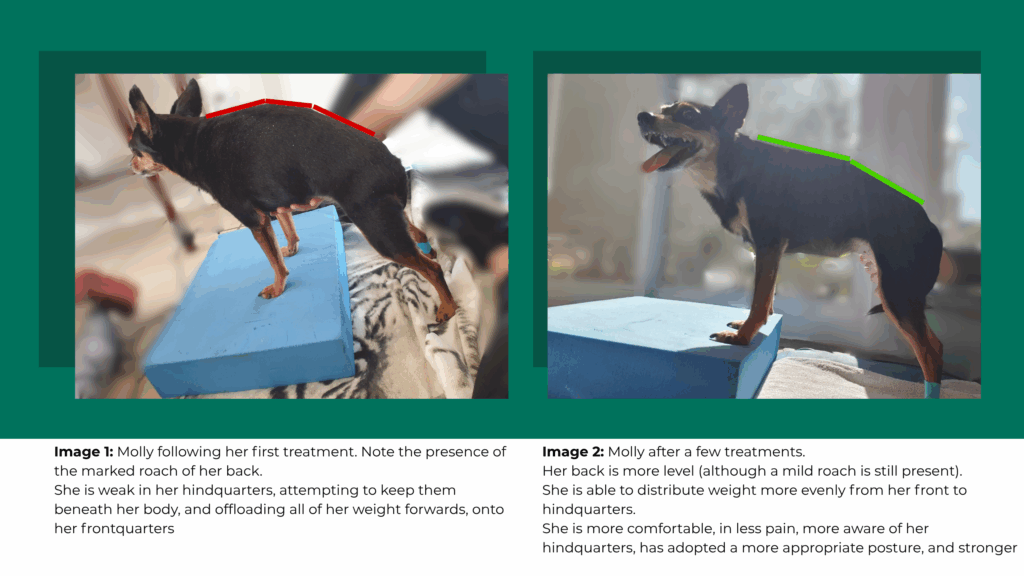
I began seeing Molly, an 8-year-old miniature pinscher, after she was referred for veterinary physiotherapy following a presumed Hansen’s Type II intervertebral disc issue (learn more about Type II discs here). Her owner had noticed she had become wobbly on her feet and was very hunched through her back—potential signs of neurological deficits and spinal discomfort.
At our first session, Molly’s posture was markedly roached (hunched). She had delayed conscious proprioception in both hind limbs—meaning she had poor awareness of where her legs were in space. Her reflexes were also delayed, suggesting the spinal cord was being affected in her lower back.
Though incredibly stoic, Molly showed significant pain in her lower back—both muscular and joint-related. She also had moderate pain in her hip flexors, likely from tucking her hind legs beneath her to 1) maintain balance and 2) reduce pressure on her spine. She had also lost noticeable muscle mass in her hind limbs, likely due to neurological deficits caused by the disc.
Molly responded well and quickly to treatment. By her second session, her back was no longer roached. Treatment focused on reducing pain, improving posture, and promoting hindlimb awareness. Her owner was given home exercises to support progress between sessions. Over time, we improved her core strength to help support her spine and reduce the risk of further degeneration.
Molly is now doing exceptionally well. Her conscious proprioception has improved significantly, she is stronger, and she is more comfortable. Her owner has noticed that her cheerful personality has returned—“She’s back to the old Molly again.”
Although there are some lasting changes—like not being allowed to jump on and off furniture due to the risk of future disc injury—Molly is once again able to enjoy her life. Ongoing veterinary physiotherapy will help keep her strong and reduce the risk of future complications.