
Cranial Cruciate Ligament Disease in Dogs: A Vet Physio’s Guide
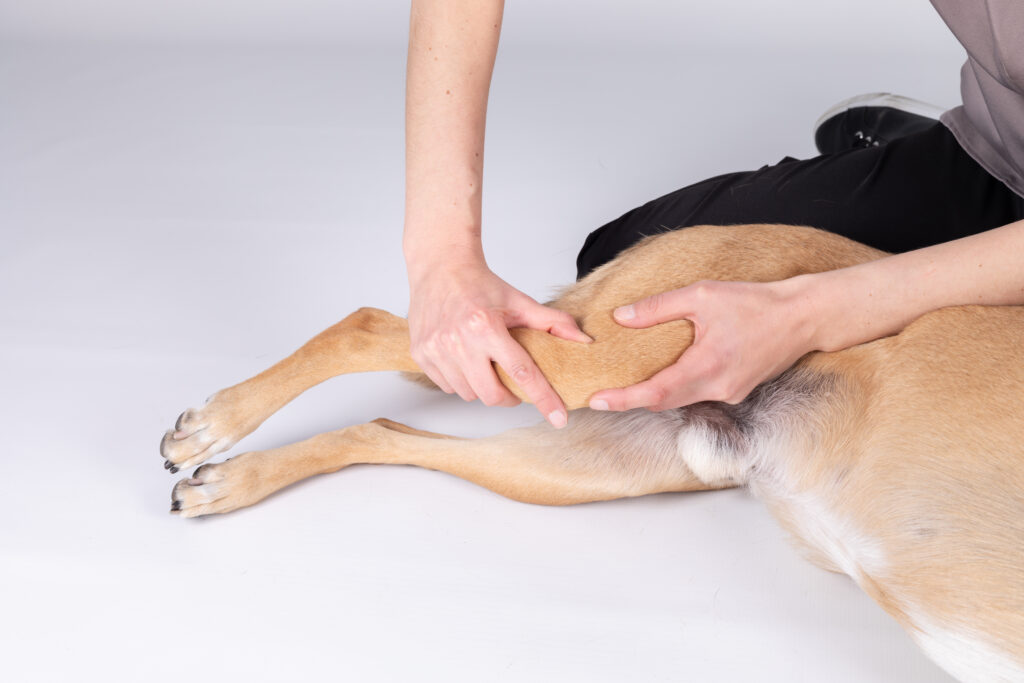
Photograph courtesy of Katja Photography
Cranial Cruciate Ligament Disease (CCLD) is one of the most common orthopedic conditions affecting dogs. The cranial cruciate ligament (CCL) is similar in function to the anterior cruciate ligament (ACL) in humans. However, unlike the traumatic ACL injuries often seen in athletes, cruciate disease in dogs is more commonly the result of a chronic degenerative process.
If your dog has been diagnosed with this disease, you’re not alone, and there are ways to help.
In this post, we’ll walk you through what CCLD is, what causes it, signs to look out for, and what treatment and rehabilitation options are available.
What is the cranial cruciate ligament (CCL)?
The cranial cruciate ligament is a key stabilizer in a dog’s knee (or stifle) joint. It prevents the shin bone (tibia) from sliding too far forward beneath the thigh bone (femur), and it helps control internal rotation of the leg.
When the CCL is injured—either partially or completely torn—it results in joint instability, pain, inflammation, and over time, the development of osteoarthritis.
What causes CCLD?
Unlike the sudden ACL tears seen in human athletes, cruciate disease in dogs is most often due to gradual degeneration over time. Several factors contribute to this condition:
Contralateral risk: Up to 60% of dogs who rupture one cruciate will eventually injure the other.
Degeneration: The ligament weakens slowly until it eventually tears.
Genetics: Breeds like Labradors, Rottweilers, Boxers, and Bulldogs are more prone.
Conformation: Structural alignment (such as a steep tibial plateau or upright hind limb angulation) places more strain on the CCL.
Body weight: Excess weight significantly increases stress on the joint.
Lifestyle: Sudden movements like jumping or twisting can rupture an already-weakened ligament.
Hormonal factors: Early neutering may influence joint development.
Other joint conditions: Issues like patellar luxation can increase strain on the ligament.
Common Signs and Symptoms
Dogs may show different signs depending on the extent and chronicity of the injury. Look out for:
- Sudden lameness or not bearing weight on one hind limb
- Difficulty rising, jumping, or climbing stairs
- Sitting with one leg out to the side (“lazy sit”)
- Swelling or thickening around the knee joint
- Muscle loss in the affected leg
Partial Tears
- Intermittent lameness that improves with rest
- Mild stiffness after rest or activity
Chronic/Untreated Injuries
- Ongoing joint thickening and arthritis
- Medial buttress (firm swelling on the inside of the knee)
- Shifting weight to the opposite leg—raising the risk of a second injury
How is CCLD Diagnosed?
Diagnosis is made by a veterinarian and typically includes:
- Physical tests like the cranial drawer and tibial thrust to assess stability
- Observation of movement and weight bearing
- X-rays to look for swelling, effusion, and arthritic changes
- Advanced imaging (like MRI) in more complex cases
- Arthroscopy, which can also be used during surgery
Treatment Options for CCLD
The most suitable treatment depends on your dog’s size, activity level, health status, and the severity of the injury. Broadly, treatment falls into surgical or conservative management.
Surgical options
Surgery is often recommended to stabilise the joint and help slow arthritis progression. Types of surgery may include:
- TPLO (Tibial Plateau Leveling Osteotomy)
Alters the angle of the tibia to eliminate the need for the CCL. - CCWO (Cranial Closing Wedge Osteotomy)
A variation of TPLO, often used in smaller dogs or those with steep tibial angles. - TTA (Tibial Tuberosity Advancement)
Realigns the pull of the patellar tendon to reduce tibial thrust. - Lateral Suture (Extracapsular Repair)
Uses a synthetic material to mimic the ligament—commonly used in small to medium-sized dogs. - TightRope and other newer methods
Stabilise the joint using advanced implant systems.
For best results and recovery post-surgery, a veterinary physiotherapist should be incorporated early on.
Conservative options
This approach is best suited to smaller dogs, dogs with partial tears, or cases where surgery isn’t an option. Success relies heavily on rehabilitation, weight management, and environmental changes.
An essential part of both surgical and conservative care:
Veterinary Physiotherapy
- Reduces pain and inflammation
- Prevents muscle atrophy and builds joint-supporting muscles
- Retrains normal movement patterns and balance
- Reduces strain on the unaffected limb
- Supports a safe, structured return to activity
Exercise Modification
- Controlled leash walks only
- No stairs, jumping, or off-leash running
- Tailored strengthening exercises targeting glutes, hamstrings, and core stabilizers
Weight Management
Maintaining a healthy weight reduces joint stress and inflammation, and helps improve outcomes.
Home Adjustments
- Use ramps instead of stairs
- Ensure non-slip flooring
- Provide soft, supportive bedding
Medical Management and Nutraceuticals
- Vet-prescribed pain relief (NSAIDs)
- Joint supplements like omega-3s, glucosamine, chondroitin, and MSM
What About Bracing?
Bracing can provide external support for some dogs, particularly when surgery isn’t an option. However, braces are not a standalone solution—they need to be used alongside physiotherapy and should be custom-fitted for proper function and comfort.
Note: Improperly fitted or passively used braces can lead to muscle loss and may worsen instability. They must be part of a carefully managed rehabilitation plan.
And Prolotherapy?
Prolotherapy is a regenerative injection therapy that promotes scar tissue formation to help stabilize the knee. While some dogs show improved comfort and movement, evidence is still emerging.
- Typically involves several sessions over a few weeks
- Often used alongside physiotherapy
- Can cause temporary inflammation or discomfort after injections
- May require sedation, especially if the joint is painful
Prolotherapy should always be considered as part of a multimodal plan. In cases where it fails to stabilise the joint, continued instability may worsen long-term joint health.
Final Thoughts
Cranial Cruciate Ligament Disease is complex but manageable. Whether your dog undergoes surgery or not, recovery and long-term function depend on a tailored, multi-modal approach involving veterinary physiotherapy, weight control, and careful activity management.
If your dog has been diagnosed with CCLD and you’re unsure about the best next steps, I’m here to help guide you through the process and support your dog’s recovery journey every step of the way.
Please don’t hesitate to get in touch if you have any questions or would like to know more about how veterinary physiotherapy can support your dog’s recovery.