
Understanding Thoracolumbar Type I IVDD: Sudden Disc Herniation in Dogs
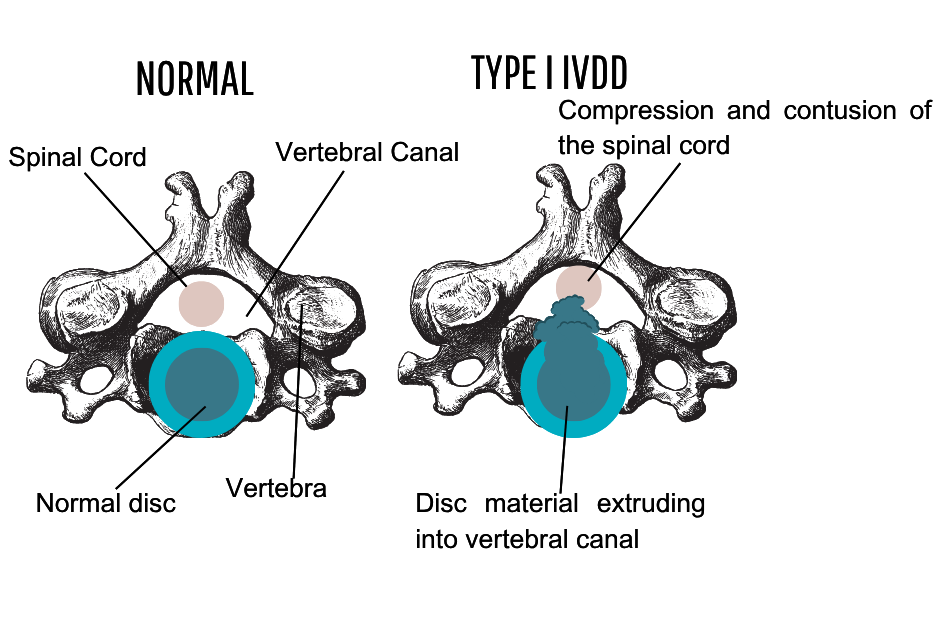
Intervertebral discs are located between adjacent vertebrae and act as cushions to help dissipate forces acting on the spine. Dogs with intervertebral disc disease (IVDD) have damaged or degenerated intervertebral discs. They can present with pain, weakness and paralysis as a result of strain on the spinal cord or nerves.
There are two types of IVDD:
- Hansen Type I: In this type, the disc material ruptures or herniates, causing the soft inner part (nucleus pulposus) to push through the outer part (annulus fibrosus), putting pressure on the spinal cord. This is more common in small breeds and chondrodystrophic dogs and can cause sudden, severe symptoms.
- Hansen Type II: In this type, the outer part of the disc bulges and protrudes into the spinal cord over time, typically leading to slower, more progressive symptoms. It is more commonly seen in older, large-breed, and non-chondrodystrophic dogs.
Type I IVDD is very different from Type II: instead of a gradual thickening, Type I involves a sudden rupture of the disc, which can cause immediate and severe pressure on the spinal cord. (Read more about Hansen Type II discs here)
This sudden herniation leads to pain, weakness, or even paralysis — but with prompt treatment and good physiotherapy, many dogs can recover well.
Type I IVDD is most common in chondrodystrophic breeds — dogs with short legs and long backs. This includes:
✔ Dachshunds (the poster pups for Type I)
✔ French Bulldogs
✔ Corgis
✔ Pekingese
✔ Shih Tzus
It usually occurs in young to middle-aged dogs (3–6 years), but older dogs can be affected too.
What Does It Look Like?
Unlike Type II IVDD, which creeps in over time, Type I IVDD often shows up out of the blue, sometimes after a jump, fall, or sudden twist. Signs can include:
- Sudden yelp or cry of pain
- Roaching of the back
- Incoordination
- Weakness in the back legs — or even sudden paralysis
- Wobbliness, dragging paws or knuckling
- Reluctance to move, or eat
- Loss of bladder or bowel control (in severe cases)
These signs are more specific to a dog with thoracolumbar IVDD (the lesion of the spinal cord occuring in the back. A lesion in the cervical (neck) region will result in differing signs and symptoms.
If you see any of these signs, call your vet immediately — Type I IVDD is an emergency!
Why Does It Happen?
In Type I IVDD, the disc’s inner material (nucleus pulposus) dries out and hardens earlier than normal, due to genetics and breed traits. If a dog twists or jumps, that brittle disc can suddenly rupture — causing disc material to push into the spinal canal and press on the spinal cord.
How Is It Diagnosed?
Your vet will check your dog’s reflexes, pain response, and movement. If IVDD is suspected, advanced imaging like an MRI or CT scan is usually needed to locate the ruptured disc and plan treatment — especially if surgery is being considered.
Treatment Options
1. Surgical Treatment
For many dogs, surgery is the best chance for recovery, especially if they have lost deep pain sensation or cannot walk. Surgery removes the disc material that’s compressing the spinal cord — the sooner it’s done, the better the chance of success.
2. Conservative Management
In mild cases, where the dog can still walk and pain is controlled, strict crate rest and medication may be enough — always under vet guidance. But even then, sudden worsening can happen, so close monitoring is essential.
How to Care for a Dog with Type I IVDD
✔ Crate rest: If prescribed, stick to it strictly. Rest means rest!
✔ Avoid jumping: Use ramps and carry your dog when needed.
✔ Weight control: Extra weight adds extra strain on the spine.
✔ Safe surfaces: Non-slip mats help prevent slips and falls.
✔ Follow-up: Stick to your rehab plan and vet check-ups — these make a huge difference.
How Can Veterinary Physiotherapy Help?
It can feel overwhelming if your dog suddenly can’t stand or walk — but take heart: the spinal cord and nerves can often heal, and veterinary physiotherapy is key to supporting this recovery.
A tailored veterinary physiotherapy plan can help your dog:
- Regain strength and coordination in their limbs
- Decrease pain (and limit muscle guarding)
- Re-train neural connections
- Improve proprioception (limb awareness)
- Normalise muscle tone and prevent muscle wastage
- Maintain joint flexibility, so stiffness doesn’t make recovery harder
- Improve balance and confidence on different surfaces
This is done step by step — starting with gentle, passive movements, and guided exercises within the dog’s functional ability that help the spinal cord’s pathways re-learn how to send and receive signals.
If your dog has had surgery, veterinary physiotherapy helps protect the surgical site while encouraging safe movement at the right pace. If your dog is on conservative rest, your vet physio plan will be carefully designed to support recovery without risking further injury.
While many dogs who couldn’t even stand at first do learn to walk again, recovery is not always guaranteed. The degree of spinal cord damage, how quickly treatment is started, and how well rest and rehab plans are followed all play a role in your dog’s outcome.
With time, patience, and the right plan, your dog has the best chance possible to get back on their paws and enjoy life again.
To read more about a real life story of IVDD, check out Sassy’s Story.